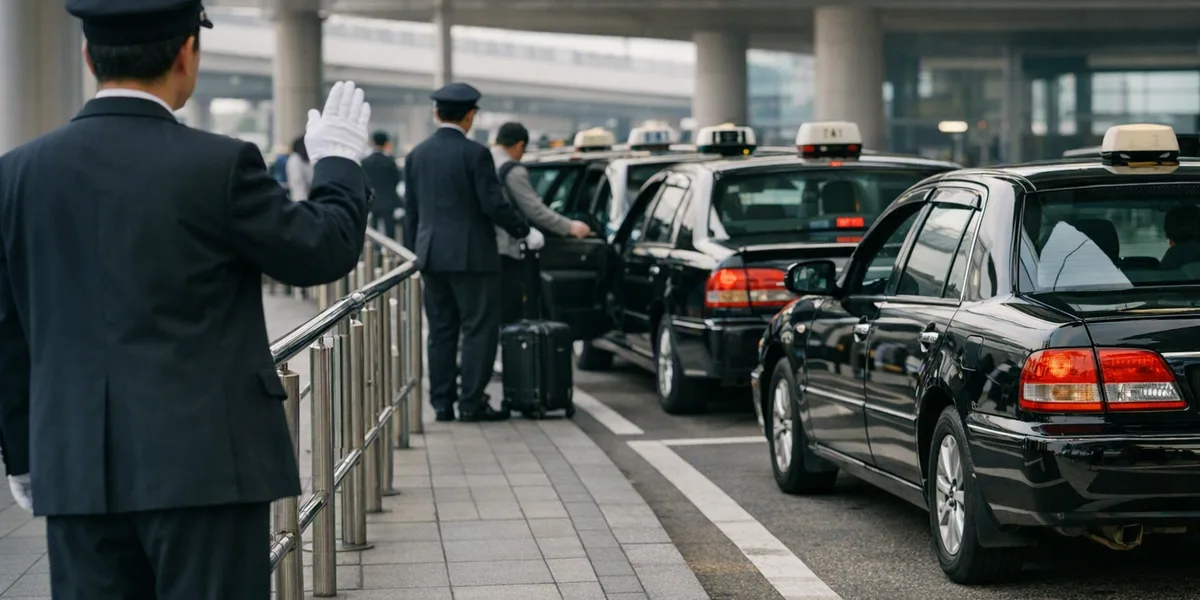
Safety is the number one concern for travelers taking taxis in unfamiliar countries. Asia's taxi landscape ranges from the impeccable honesty of Japan and Singapore to the Wild West of Indian airports. This guide ranks the safest countries for taxi travel based on driver honesty, vehicle condition, meter transparency, female traveler safety and overall reliability.
Japanese taxis are in a class of their own. Drivers wear white gloves, vehicles are spotless inside and out, the back doors open and close automatically (never touch them yourself), and the meter is always running. No Japanese driver will ever overcharge you, take a detour, refuse the meter or suggest a different hotel. Tipping is not customary - it may even be refused. The only real downside is cost: a taxi from Narita to central Tokyo can hit $170–240 by meter, which is why pre-booked transfers are so popular in Japan.
At regional airports like Fukuoka (FUK) or Naha (OKA), taxis are more affordable. Solo female travelers can take taxis at any hour, anywhere in Japan, without concern. Safety rating: 10/10.
Singapore's taxi system is regulated to perfection. Meters are transparent, surcharges are clearly posted, and Grab provides an additional layer of accountability. The city is one of the safest in the world - violent crime is essentially nonexistent. Late-night surcharges are the only surprise, and these are clearly displayed in every taxi.
Korean taxis are metered, safe and generally honest. The biggest challenge is the language barrier - most drivers speak minimal English. Kakao T (the dominant ride-hailing app) provides English support but setup can be tricky. Deluxe (black) taxis cost more but drivers tend to have better English. Seoul is very safe at all hours.
Dubai and Abu Dhabi taxis are metered, air-conditioned and regulated by government transport authorities. Drivers are honest and vehicles are well-maintained. The Careem and Uber apps add transparency. Women can request female drivers through Careem. The UAE is extremely safe for all travelers.
Hong Kong taxis use meters and drivers are generally honest, though some prefer Cantonese-speaking passengers. Taiwan is similar - metered, safe and cheap. Neither country has significant taxi scam problems. Both are excellent for solo female travelers.
Malaysian taxis vary in quality, but Grab has transformed the experience. The app provides upfront pricing, driver identification and GPS tracking. Official airport taxi counters use a transparent coupon system. Overall safe, with Grab as the recommended default.
Thailand is mostly safe for taxi travel, but meter-refusal and overcharging are common annoyances at tourist hotspots. In Bangkok, metered taxis from Suvarnabhumi BKK are affordable when the driver actually uses the meter - but some drivers outside the official queue will quote a flat 800 THB for a 300 THB ride. Phuket HKT has the worst airport taxi situation in the country: a local cooperative controls all transport and charges 2–3 times what a Grab ride would cost.
Chiang Mai CNX and Krabi KBV are much more relaxed. Grab has dramatically improved the taxi experience across Thailand and is the recommended default for anyone with a smartphone. Solo female travelers are generally safe during the day, but should use Grab or a pre-booked transfer after midnight, especially in Bangkok and Pattaya.
These three countries require more caution than the rest of the list. In the Philippines, Manila NAIA is the most problematic airport in Southeast Asia - four disconnected terminals, persistent taxi scams, meter refusal and aggressive touts make it stressful for first-time visitors. Use Grab or the yellow airport taxi queue, never a random approach. In Vietnam, fake taxi companies with rigged meters are the primary threat at Hanoi HAN and Ho Chi Minh City SGN - only trust Mai Linh (green) or Vinasun (white).
In Indonesia, the airport taxi cartel at Bali DPS charges inflated fixed prices and physically blocks Grab from entering. Pre-booking is essential. Outside the airports, all three countries are generally safe and welcoming. The problems are concentrated at arrival points where tired travelers are easy targets. Grab has transformed safety in all three countries - use it as your default.
India has the most challenging taxi environment in Asia. Delhi DEL is ground zero for airport scams - the "hotel is closed" trick, rigged meters and aggressive touts operate around the clock. Mumbai BOM and Bangalore BLR are better organized but still require alertness. Always use the prepaid taxi counter or Ola/Uber, and never follow anyone who approaches you inside the terminal. In Cambodia, the new Siem Reap airport REP is 50 km from the city with zero public transport - pre-booking is mandatory, not optional.
Phnom Penh PNH is more manageable with PassApp or Grab. Myanmar's Yangon RGN has limited ride-hailing and taxi quality varies. Pre-book your transfer to avoid confusion. Female travelers should take extra precautions for late-night rides in all three countries - use only pre-booked transfers or verified ride-hailing apps, never a random taxi.
Every issue discussed in this guide - overcharging, scams, language barriers, unreliable apps, long queues - has one simple solution: pre-book your airport transfer before you fly. A pre-booked transfer gives you a fixed price confirmed in advance, a named driver tracking your flight and waiting at arrivals, and zero negotiation. Most vehicle classes can be cancelled free of charge up to 5 hours before pickup, so booking early costs you nothing.
Start by checking our airport guides below for specific local advice, prices and transport options at your arrival airport.
Read our detailed transfer guides for airports mentioned in this article:
Specific route guides with prices and transport comparisons: