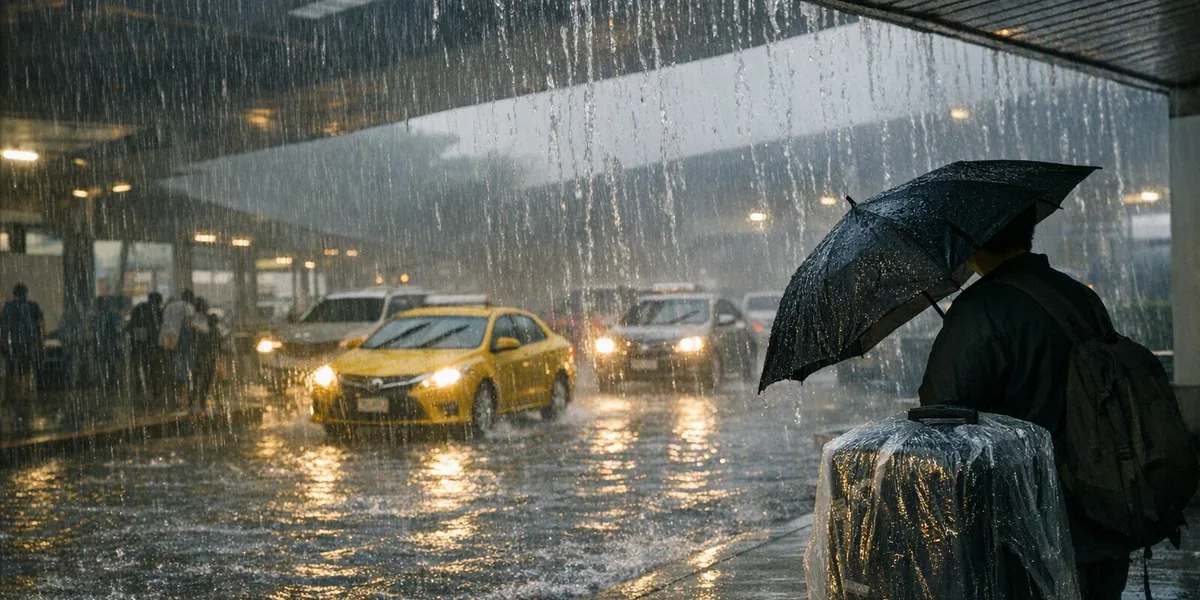
Between June and October, Asia's monsoon season transforms airport transfers from routine to unpredictable. Bangkok's Suvarnabhumi (BKK) sees surge pricing jump 250% during afternoon downpours, while Mumbai's flooded arterial roads can triple your 45-minute ride to 3 hours. Manila's Ninoy Aquino International (MNL) regularly closes Terminal 3 access roads when rainfall exceeds 50mm in an hour. Bali's Ngurah Rai (DPS) faces similar challenges during the December-March wet season. This guide covers real-time booking strategies, alternative transport modes, and how to avoid the worst delays when tropical rain hits Asia's busiest airports.
Grab's dynamic pricing algorithm triggers 1.5x-3.0x multipliers within 15 minutes of heavy rain across Southeast Asia. At BKK during July 2025, standard airport rides from 350-400 THB jumped to 850-1,200 THB between 3-6pm when thunderstorms hit. InDrive, which allows price negotiation, shows drivers demanding 800-900 THB for routes normally costing 500 THB during dry conditions. Mumbai's Uber rates from Chhatrapati Shivaji Maharaj International (BOM) to South Mumbai surge from ₹650 to ₹1,800+ when the monsoon flooding blocks the Western Express Highway.
Gojek in Jakarta applies similar multipliers, though Indonesia's capital sees less extreme weather than Mumbai or Manila. The key pattern: surge peaks 30-90 minutes after rain starts, when demand spikes but driver supply drops. Booking 2-3 hours before your flight during monsoon months locks rates before weather triggers algorithms. Pre-booking through taxi.asia's partner operators avoids surge entirely with fixed-rate transfers, particularly valuable for early morning flights when overnight rain floods approach roads.
Mumbai's BOM airport becomes partially isolated when the Mithi River overflows, flooding sections of the Western Express Highway and Andheri Kurla Road. During the 2024 monsoon, the airport reported 18 days when ground transport delays exceeded 90 minutes due to waterlogged roads. Bangkok's elevated motorway to BKK handles rain better, but surface road alternatives flood in Lat Krabang and Bang Phli districts when rainfall tops 80mm daily. Manila faces the worst conditions among major Asian hubs-NAIA terminals sit in low-lying areas where even moderate 30-40mm rainfall floods access roads.
The notorious Roxas Boulevard approach becomes impassable during high tide combined with heavy rain, forcing detours through already-congested C5 road. Bali's DPS airport access via Jalan Ngurah Rai rarely floods completely but experiences severe congestion when rain forces single-lane traffic. Singapore's Changi (SIN) has excellent drainage and rarely sees weather-related ground delays, making it the regional exception. Check local traffic apps 2-3 hours before departure: Google Maps shows red/dark-red traffic, while Moovit provides real-time flood warnings in Manila and Mumbai.
Bangkok's Airport Rail Link remains the most reliable monsoon transfer option, running every 15 minutes from BKK to Phaya Thai station with zero weather delays in 2025. The 45-minute journey costs just 45 THB versus 800-1,200 THB surge-priced taxis during storms. However, the train doesn't serve many hotels directly-you'll need connecting transport. Mumbai's Metro Line 2A from BOM to Andheri opened in 2025, providing flood-proof transfer in 20 minutes for ₹60, though it only connects to the Western Line suburban network.
KLIA Ekspres in Kuala Lumpur maintains perfect punctuality during Malaysia's November-January monsoon, covering the 57km to KL Sentral in 33 minutes for RM55. Manila lacks airport rail entirely, leaving passengers stuck with taxis or ride-apps when flooding hits. Bali similarly has no rail option to DPS. The pattern is clear: cities with elevated airport rail systems (Bangkok, Kuala Lumpur, Delhi) maintain schedule reliability, while road-dependent transfers (Manila, Bali, much of Indonesia) suffer significant delays.
For monsoon travel to airports without rail, book private transfers 4+ hours ahead rather than relying on real-time ride-apps.
Monsoon weather delays 15-25% of flights at affected airports, creating coordination nightmares for pre-booked transfers. When your BKK-bound flight circles for 45 minutes waiting for thunderstorms to pass, your driver may cancel or charge waiting fees. InDrive and Grab allow you to message drivers directly about delays, but response rates drop to 40-50% during peak evening storms when drivers field multiple booking requests. Fixed-rate transfer services through taxi.asia's partners typically include 60-90 minutes free waiting time, crucial when flights stack up during weather.
Mumbai's BOM saw average delays of 47 minutes during the 2025 monsoon according to FlightStats data, with evening arrivals from Europe and Middle East most affected. Manila experiences similar patterns, with domestic flights from Cebu and Davao often delayed 1-2 hours when afternoon convective storms develop. The solution: book transfers that explicitly include flight tracking and extended waiting periods. Budget ride-apps work fine for on-time arrivals in clear weather, but monsoon season demands more flexible arrangements.
Airport standby taxis charge 150-200% premiums during heavy rain and flight delay situations, making pre-arranged transfers with waiting time the most cost-effective hedge.
Manila taxi drivers default to EDSA or C5 during floods, but the lesser-known Skyway elevated expressway remains clear when surface roads submerge. Insist on Skyway routing from NAIA to Makati or BGC areas-it adds ₱274 in tolls but saves 45-90 minutes during heavy rain. In Bangkok, the Motorway Route 7 stays passable when Bang Na-Trat Highway floods, though not all drivers know the junction connections. Mumbai locals use the Jogeshwari-Vikhroli Link Road as a BOM airport bypass when the Western Express Highway floods, though this requires driver familiarity with Powai routing.
Bali drivers often stick to the coastal Jalan Ngurah Rai route, but the inland bypass through Jimbaran via Jalan Uluwatu reduces flood exposure by 60%. The challenge: ride-app routing algorithms don't account for real-time flood conditions, only historical traffic data. When booking during active rainfall, call your driver and specify elevated routes or bypasses. Fixed-rate transfer operators with local expertise automatically adjust routing based on current conditions-this local knowledge justifies their premium over budget ride-apps during monsoon season.
NAIA in Manila regularly implements single-road access during flooding, closing Terminal 3's main approach and forcing all traffic through the Terminal 1/2 road when water levels exceed 30cm. This happened 12 times during the 2024 monsoon season, creating 2-4 hour delays for passengers who arrived during implementation. BKK has never fully closed access roads due to superior drainage, but did restrict one lane during September 2023 repairs after flood damage.
Mumbai's BOM closed the Andheri approach twice in 2024, routing all traffic through Kurla with massive congestion. When closure happens, airport authorities notify via Twitter/X and official apps, but information reaches drivers 15-45 minutes late. Passengers get no direct notification unless they follow airport social media accounts. DPS Bali posts closure information on Instagram but only in Bahasa Indonesia, leaving international travelers unaware. The practical solution: check airport social media 3-4 hours before departure during monsoon season.
If access roads are closed or restricted, leave an extra 90-120 minutes beyond normal transfer time. Some airports offer emergency shuttle services during closures, but these are inconsistent and poorly advertised.
For BKK transfers June-October, book at least 3 hours ahead for afternoon/evening departures when Bangkok's daily thunderstorms peak between 2-7pm. Morning flights rarely face weather issues. Mumbai requires the longest buffer during July-September peak monsoon: book 4-5 hours ahead for any departure time, as overnight rain floods roads that don't drain until afternoon. Manila's worst window is June-August, with afternoon convective storms developing 70% of days; book 3-4 hours ahead for flights after 2pm.
Bali's wet season (December-March) sees morning rain more often than afternoon, so departures before 11am need 3-hour booking buffers. The pattern across all cities: booking 12-24 hours ahead eliminates surge pricing risk entirely, as rates are fixed before weather develops. Last-minute bookings (under 60 minutes) during active rain carry 200-300% price premiums and high cancellation risk. Consider booking roundtrip transfers when you arrive-lock in return rates before monsoon weather hits.
Most vehicle classes can be cancelled free of charge up to 5 hours before pickup, giving you flexibility if your flight changes while protecting against surge pricing.
When flooding or delays strand you at the airport, airport hotel shuttles often continue running when public transport stops. BKK's Novotel Suvarnabhumi operates shuttles every 30 minutes even during heavy rain, and you can use the service for ₹450-500 to reach the hotel, then grab a taxi from there to Bangkok after weather clears. Mumbai's airport hotels cluster in Andheri and Vile Parle, accessible via service roads that flood less than main highways.
Manila's NAIA has limited hotel shuttle options, but Marriott and Sofitel near Terminal 3 operate 4x4 vehicles during floods. The nuclear option: wait it out at the airport. BKK has excellent facilities including sleeping pods, showers, and 24-hour restaurants. BOM's newer Terminal 2 has comfortable waiting areas but limited sleeping options. NAIA is notoriously uncomfortable for overnight stays. Another alternative: motorcycle taxis (Bangkok's motosai, Manila's habal-habal) navigate flooded roads when cars can't, though this works only with carry-on luggage.
Grab and Angkas (Philippines) offer bike options for solo travelers. Expect to pay 300-400 THB in Bangkok or ₱400-600 in Manila for airport bike transfers during floods-expensive but faster than waiting for roads to clear.
Many travel insurance policies cover additional ground transport costs due to weather delays, but require specific documentation. Save screenshots of surge pricing, driver messages about road closures, and photos of flooded roads if you need to claim €50-200+ in excess transfer costs. Allianz and World Nomads policies typically cover documented monsoon-related transport expenses under trip delay provisions, with €100-150 daily limits after 6-12 hour qualifying delays.
Airlines don't reimburse ground transport affected by weather, but EU261 regulations cover some situations when you miss connections due to arrival delays at European carriers serving Asian airports. Singapore Airlines, Thai Airways, and Philippine Airlines all codeshare with European carriers, potentially triggering compensation rights. If flooding makes you miss a prepaid transfer booking, most operators refund within 48 hours with proof of flight delay or road closure.
Budget ride-apps rarely refund cancellations, even during force majeure weather. Keep your taxi.asia booking confirmations and any operator communications about delays or route changes as evidence. Travel delay claims succeed 70% more often when you have timestamped photos and driver messages rather than just verbal explanations.
Every issue discussed in this guide - overcharging, scams, language barriers, unreliable apps, long queues - has one simple solution: pre-book your airport transfer before you fly. A pre-booked transfer gives you a fixed price confirmed in advance, a named driver tracking your flight and waiting at arrivals, and zero negotiation. Most vehicle classes can be cancelled free of charge up to 5 hours before pickup, so booking early costs you nothing.
Start by checking our airport guides below for specific local advice, prices and transport options at your arrival airport.
Read our detailed transfer guides for airports mentioned in this article:
Specific route guides with prices and transport comparisons: