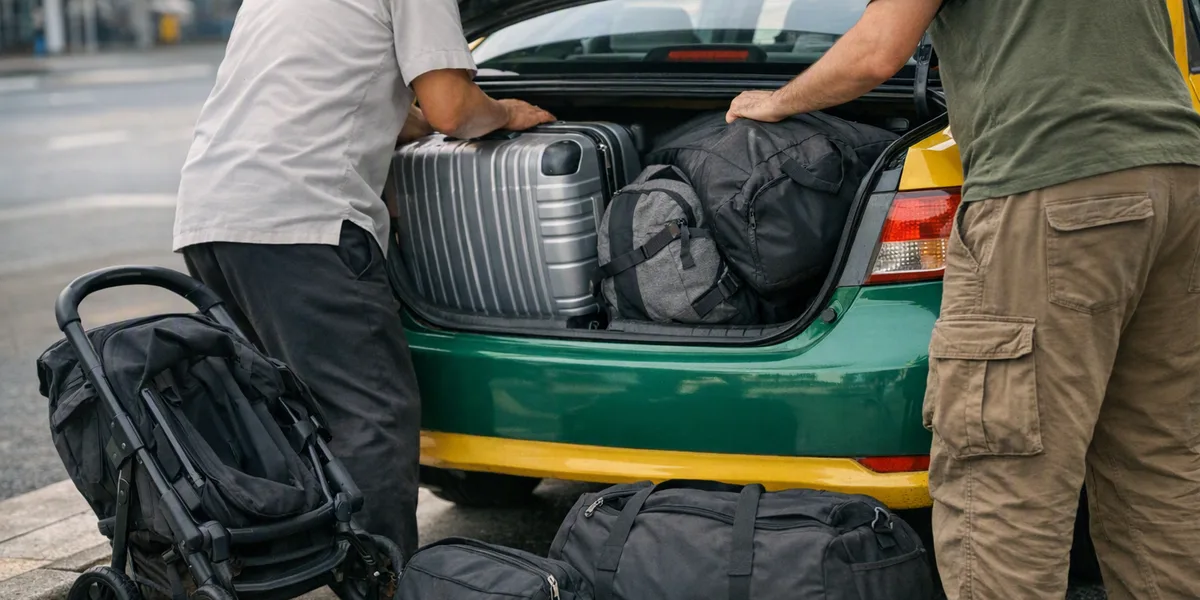
You've booked a sedan through Grab at Changi Airport, but you're traveling with two large suitcases, a golf bag, and a carry-on. Will it fit? Across Asia, taxi trunk sizes vary dramatically-a Bangkok Altis Corolla holds far less than a Jakarta Avanza minivan. Golf clubs cause chaos at Phuket (HKT), surfboards get rejected at Ngurah Rai (DPS), and ski gear creates confusion at Narita (NRT). This guide breaks down actual luggage capacities for the sedans, minivans, and SUVs you'll encounter at major Asian airports, with real measurements and booking strategies for oversized items.
The Toyota Corolla Altis and Honda Civic dominate airport taxi fleets from Singapore to Manila, but their 450-liter trunks aren't generous by Western standards. At Changi Airport, a standard ComfortDelGro sedan comfortably holds two 28-inch checked bags plus two carry-ons for a couple, but three travelers with full-size luggage will struggle. The trunk opening on most Asian-market sedans measures 95cm wide-golf bags fit diagonally, but rigid ski cases over 180cm won't.
Bangkok's metered taxis use the same Altis platform; drivers at Suvarnabhumi (BKT) frequently pop the trunk, realize the third large suitcase won't fit, then request you book a larger vehicle through the official queue system. At Narita, standard sedan taxis (普通車) explicitly accommodate "2 passengers with 2 large suitcases" according to Narita Airport Transport signage-anything beyond that requires upgrading to a wagon or alphard. Real-world tip: if your total checked bags exceed passenger count, book a minivan upfront to avoid re-queuing or paying surcharges at pickup.
The 7-seater Toyota Avanza represents Asia's luggage solution, with 1,510 liters of cargo space when the third row folds flat. At Ngurah Rai Airport in Bali, Blue Bird's Avanza fleet handles the surf-and-family crowd-four passengers with two longboards (up to 240cm) plus standard luggage fit with the third row down. The trunk floor sits low, so stacking three 28-inch bags vertically is straightforward. Grab and Bolt both offer "6-seater" categories at Phuket and Bangkok that default to Avanza or similar MPVs, typically 30-40% more expensive than sedans but worth it for groups of 3-4 with beach gear.
The premium step-up, Toyota Alphard, appears in Singapore's premium taxi fleets and Narita's MK Taxi service-sliding rear doors, 1,100 liters behind the second row, and crucially, a flat load floor that accepts four full-size golf bags horizontally. Alphard rides at Changi through TADA or Ryde cost S$55-70 to the city versus S$25-35 for sedans, but for four golfers splitting the fare, it's the only civilized option.
The Alphard's width (1.85m) also matters: oversized cardboard boxes from duty-free shopping sprees actually fit.
The Toyota Fortuner and Mitsubishi Pajero Sport dominate Asia's "SUV" taxi categories, but travelers expecting American-size cargo space get disappointed. A Fortuner's trunk with the third row up holds just 200 liters-barely more than a sedan. The third row must fold (increasing capacity to 716 liters) to accommodate three large suitcases, which means maximum 5 passengers, not the advertised 7. At Phuket Airport, families booking a "7-seater SUV" through Klook often discover the third row must stay down for their luggage, forcing a second vehicle booking.
Real capacity: two adults, two kids, three large bags, two carry-ons-comfortable. Four adults with four large bags-tight. The Pajero Sport offers slightly better dimensions (1,488 liters, third row flat) and appears frequently in Manila and Jakarta airport fleets. InDrive and Maxim in Southeast Asia sometimes categorize these as "Comfort" or "XL" rather than SUV, which more accurately reflects their role as spacious sedans rather than true cargo haulers.
If you genuinely need both 6+ passengers and substantial luggage, specify a van (Hiace, Alphard) explicitly in booking notes.
Golf tourism drives specific luggage infrastructure at certain Asian airports. Phuket Airport serves 20+ golf courses within 90 minutes, so metered taxis at the official stand accommodate hard golf cases up to 130cm without question-drivers routinely angle them from trunk to back seat footwell. The airport's official taxi app lets you pre-note "golf equipment," which assigns larger sedans (Camry wagons) or ensures an Avanza if available. At Changi Airport, Singapore's obsession with golf means every ComfortDelGro driver has loaded clubs before-soft travel bags fit in sedan trunks (450L), but hard Samsonite-style cases often require the front passenger seat to remain empty so the case slides between front seats into the footwell.
GrabCar Premium at Changi doesn't guarantee larger trunks, just newer cars; for guaranteed golf capacity, book "GrabCar 6-seater" or use TADA's MPV option. Narita Airport caters to Japan's golf culture with specialized "Golf Taxis"-pre-bookable MK Taxi or Nihon Kotsu wagons with confirmed club space, costing ¥24,000-28,000 to central Tokyo versus ¥20,000 for standard sedans. Two golfers with two bags each need a wagon minimum; four golfers require an Alphard or similar.
Ngurah Rai Airport receives thousands of surfers monthly, yet surfboard transport remains inconsistent. Bluebird taxis officially accept boards up to 220cm if booked via their MyBluebird app with "oversized luggage" selected-this triggers dispatch of an Avanza or ensures the driver expects gear. Standard sedans cannot fit boards over 180cm even diagonally. Grab and Gojek in Bali don't have formal oversized-item categories, so drivers sometimes cancel on arrival when they see longboards; avoid this by messaging through the app immediately after booking: "2 surfboards, 210cm each." Rates don't officially change, but expect drivers to request Rp 50,000-100,000 extra cash for "inconvenience"-frustrating but common.
Dive gear (BCD, tanks, fins) presents less drama; two full dive kits fit in sedan trunks alongside personal bags, though tank valves sometimes scratch interior panels (carry a towel to wrap them). Some Bali villa transfer services (Klook, GetYourGuide) explicitly include surfboard transport in their pricing, typically $5-8 more than standard cars-worth it for stress-free airport pickup at 11 PM after a long flight from Perth or Seoul.
Narita Airport serves millions heading to Nagano, Niseko, and Hokkaido ski resorts, yet most taxis struggle with ski gear. Standard sedan trunks won't accommodate 170cm+ ski bags-the bags must ride inside with seats folded. Narita's official shared shuttle services (Airport Limousine Bus) to Tokyo hotels include under-bus cargo holds that easily handle ski equipment, costing ¥3,200 versus ¥20,000+ for a private taxi. If you must take a taxi, book a wagon (ワゴン車) or alphard explicitly through MK Taxi's English website, noting "ski equipment for X persons." Four skiers with four full ski bags need an alphard minimum, and the ¥28,000-32,000 fare reflects that capacity.
South Korea's Incheon Airport (ICN) sees similar winter traffic to Pyeongchang-KakaoTaxi's "Large" category assigns Carnival or Starex vans that handle ski gear, but you'll pay ₩85,000-110,000 to Seoul versus ₩65,000 for sedans. Cheaper option: airport rail (AREX) to Seoul Station, then taxi to your hotel-stations have elevators and ski storage is straightforward. China's Changbaishan Airport (NBS) serving Wanda ski resort has official transfer vans included in many hotel packages; independent taxis are scarce and luggage space unpredictable.
Every major Asian ride-hailing app handles luggage differently. Grab's vehicle categories vary by country-"GrabCar 6-seater" in Thailand and Indonesia reliably assigns minivans, while "JustGrab" gives you whatever's closest (often a sedan). InDrive lets you negotiate directly with drivers; message them your luggage specs before confirming the ride. Bolt in Southeast Asia shows driver vehicle model before you confirm-if you see "Avanza" or "Ertiga," you've got van space; if it says "Vios," you don't.
Gojek in Indonesia offers "GoCar XL," but availability at airports is inconsistent outside Jakarta and Bali. For guaranteed capacity, pre-book through airport-specific services: Changi has official partnerships with TADA and Ryde that show vehicle type before payment; Phuket Airport's own app (AOT Airport) assigns numbered taxis with vehicle size confirmed. Narita and Tokyo's MK Taxi, Nihon Kotsu, and Hinomaru all offer English websites with vehicle photos and luggage specs-more expensive (¥24,000-32,000) but zero surprises.
Always add "Oversized luggage: [specific item and dimensions]" in booking notes; drivers appreciate the transparency and won't cancel on arrival.
Math matters. At Changi Airport, a GrabCar sedan to Orchard Road costs S$25-30; a GrabCar 6-seater costs S$40-48. For two travelers with standard luggage, the sedan works fine. For four travelers with four large bags plus golf clubs, the extra S$15 prevents the disaster scenario of a cancelled ride, 20-minute re-queue, and potential second vehicle charge. Phuket's official metered taxis charge ฿100-150 surcharge for "oversized items," but that's added at the driver's discretion-better to book an Avanza through Bolt (฿650-800 to Patong) than risk arguments with a metered driver over a surfboard.
Bali's Blue Bird premium sedans (Silver Bird) cost only 20% more than standard but don't offer more trunk space-skip them for luggage purposes; their Avanza fleet through MyBluebird app is the same price as Grab's 6-seater. Tokyo's airport limousine buses (¥3,200) include huge luggage holds and door-to-door hotel service-four travelers splitting that cost pay less than a single taxi while getting more luggage space. The calculus shifts at 3+ travelers with substantial gear: minivans and premium vans become cost-effective, not luxury splurges.
Across most Asian airports, drivers help load luggage into the trunk-it's standard practice at Changi, Suvarnabhumi, and Incheon. However, they typically don't carry bags to/from terminals; you wheel them to the taxi stand, they load the trunk, you unload at your hotel. Japan represents an exception-Narita taxi drivers often assist with luggage all the way to hotel lobbies, and tipping isn't expected (though appreciated by younger drivers).
Singapore's taxi drivers at Changi will load bags but appreciate if you handle your own carry-ons; tipping isn't mandatory but S$2-5 for exceptional help with heavy items is becoming common. In Bali and Thailand, metered taxi drivers expect you to handle your own bags unless they're exceptionally heavy-offering Rp 20,000 or ฿20-50 for help with multiple large bags smooths interactions. Golf bags and surfboards require more cooperation; drivers position them while you guide from outside the vehicle.
If a driver refuses to transport your gear due to size (rare but happens with rigid ski cases), don't argue-request another vehicle through the app rather than force an unsafe situation. Most disputes arise from surprise, not malice; pre-booking with specific item descriptions prevents 95% of conflicts.
Every issue discussed in this guide - overcharging, scams, language barriers, unreliable apps, long queues - has one simple solution: pre-book your airport transfer before you fly. A pre-booked transfer gives you a fixed price confirmed in advance, a named driver tracking your flight and waiting at arrivals, and zero negotiation. Most vehicle classes can be cancelled free of charge up to 5 hours before pickup, so booking early costs you nothing.
Start by checking our airport guides below for specific local advice, prices and transport options at your arrival airport.
Read our detailed transfer guides for airports mentioned in this article:
Specific route guides with prices and transport comparisons: