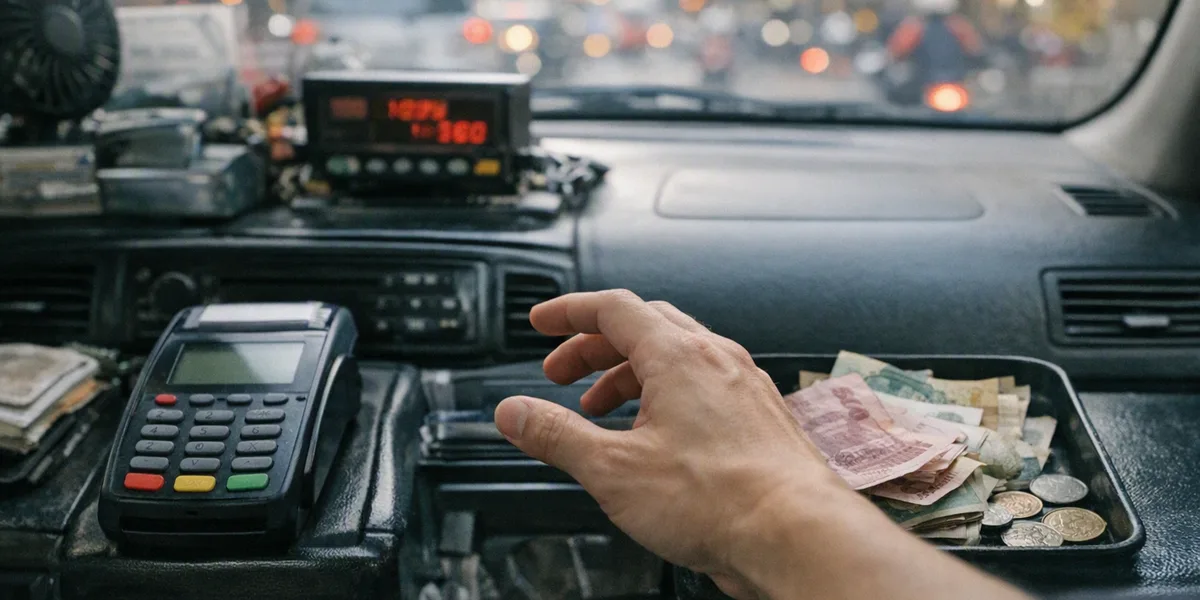
Payment acceptance for airport taxis varies wildly across Asia. In Tokyo, tapping your credit card is standard. In Manila, you'll need pesos. Bangkok's hybrid system accepts both, while Mumbai's prepaid counters mostly run on cash. This guide breaks down exactly which payment methods work at major Asian airports, where to withdraw local currency without getting gouged, and which ride-hailing apps let you skip the payment hassle entirely. Whether you're landing at Suvarnabhumi (BKK), Narita (NRT), Chhatrapati Shivaji (BOM), or Ninoy Aquino (MNL), here's what actually works when you need a ride.
Narita International Airport (NRT) represents the gold standard for cashless taxi payments in Asia. Official taxi stands outside both Terminal 1 and Terminal 2 accept Visa, Mastercard, and increasingly Amex without question. The fixed-fare Narita taxi service to central Tokyo (¥20,000-22,000) processes cards through modern terminals installed in every vehicle. JapanTaxi and GO, the dominant ride apps, handle payment entirely in-app using international cards. However, smaller independent cabs occasionally prefer cash, and tipping isn't practiced anywhere in Japan.
Keep ¥10,000 in cash for these rare situations. Seven Bank ATMs in the arrivals hall accept foreign cards with minimal fees (¥110 plus your bank's charge). The exchange rate at airport counters runs 3-5% worse than ATM withdrawal rates. For stays beyond Tokyo, load a Suica card with ¥5,000 at the JR East Travel Service Center-this rechargeable IC card works for trains but not taxis, though it's essential for navigating Japan efficiently.
Suvarnabhumi Airport (BKK) operates a mandatory meter taxi system that's 90% cash-based despite Thailand's digital payment boom. The official taxi queue on Level 1 issues tickets to licensed metered cabs charging ฿50 airport surcharge plus meter fare (typically ฿350-450 to central Bangkok). Drivers expect Thai baht-credit cards simply aren't equipped in these vehicles. Grab dominates the ride-app space here and accepts international credit cards through the app, with GrabCar Premium guaranteed to have card readers for ฿500-650 to Sukhumvit.
Bolt recently entered Bangkok with similar pricing and payment flexibility. Exchange counters airside offer poor rates (฿33-34 per USD versus ฿36-37 downtown), but the Krungsri and Bangkok Bank ATMs in the arrivals hall give near-official rates with ฿220 withdrawal fees. For a week-long stay, withdraw ฿5,000-8,000 immediately. The AOT Limousine counter accepts cards for fixed-rate premium service (฿1,200-1,500) if you're carrying heavy luggage and want certainty.
Street taxis outside the official queue often quote inflated fixed prices-avoid these entirely and use the meter queue or Grab.
Chhatrapati Shivabi Maharaj International Airport (BOM) runs prepaid taxi counters that technically accept cards but function far more smoothly with rupees. The Meru and Mumbai Taxi counters in the arrivals area quote fixed rates (₹900-1,100 to South Mumbai, ₹600-800 to Bandra) and have card machines, but transaction failures are common, especially late at night when connectivity drops. Experienced travelers withdraw ₹5,000-10,000 from HDFC or ICICI ATMs located past customs in the arrivals hall-these charge ₹200-250 per transaction plus 2-3% foreign exchange markup from your bank.
Uber and Ola both operate from BOM with in-app payment, though surge pricing during 6-9 AM and 5-8 PM can double base fares. Ola's 'Cash' option often gets faster pickup times than card bookings during peak hours, counterintuitively. The black-and-yellow Premier Padmini cabs still operating here are cash-only relics, charming but inconvenient. For airport convenience, BluSmart operates an all-electric fleet with mandatory card payment through their app, though availability drops significantly after 11 PM.
Currency exchange booths airside offer ₹81-82 per USD versus ₹85-86 official rates-a 5% haircut you should avoid.
Ninoy Aquino International Airport (MNL) across its four terminals operates in a predominantly cash economy for taxis. The yellow airport taxis use meters with ₱70 flag-down rates but rarely carry card terminals-expect to pay ₱400-600 to Makati or BGC in pesos. White Grab/Uber-style cabs at the ride-hailing pickup zones (Terminal 3 has dedicated bays) accept app payment with international cards, pricing ₱550-750 for the same routes.
Grab Philippines processes thousands of airport pickups daily with reliable card payment. The catch: Philippine banks' ATMs charge aggressive fees. BDO and BPI machines in arrivals levy ₱250 per withdrawal plus whatever your home bank adds, making small withdrawals expensive. Smart strategy: take out ₱10,000-15,000 once to minimize per-transaction fees. Couriers Airport Service operates premium vans with card payment capability at ₱1,500-2,000 rates, marketed to business travelers.
The currency exchange booths offer roughly ₱54-55 per USD versus ₱57-58 interbank rates-only use these for emergency small amounts. TNVS (Transport Network Vehicle Service) cars booked through Grab completely bypass payment friction, making them the practical choice for card-only travelers despite 15-20% higher costs than regular taxis.
Singapore Changi (SIN), Hong Kong (HKG), Seoul Incheon (ICN), and Taipei Taoyuan (TPE) join Tokyo as genuinely card-friendly airports where taxis accept plastic without hesitation. Singapore's taxi fleet runs mandatory card readers; the ₱35-45 ride to downtown processes on Visa/Mastercard instantly. Hong Kong's red urban taxis increasingly take Octopus cards and contactless credit cards, though cash remains common for the HK$300-350 airport run.
Seoul's premium KAL Limousine buses (₩16,000) and official taxis both handle cards smoothly, though the Kakao T app dominates with in-app payment. Taiwan's taxi fleet at Taoyuan accepts cards for the NT$1,200-1,400 trip to Taipei, though many drivers prefer cash to avoid 2-3% merchant fees. The pattern: wealthier, more regulated Asian markets mandate card infrastructure. Malaysia's KLIA, Indonesia's CGK Jakarta, Vietnam's SGN Ho Chi Minh, and Cambodia's REP Siem Reap all lean heavily cash-preferring despite growing digital payment ecosystems.
Kuala Lumpur's airport taxis technically accept cards but 'broken terminal' excuses appear frequently. Hanoi's Noi Bai and Ho Chi Minh's Tan Son Nhat airports have Grab/Gojek with app payment, but traditional taxis want Vietnamese dong.
Foreign transaction fees stack quickly when using ATMs abroad: the machine's operator fee (¥110 in Japan to ₱250 in Philippines), your bank's foreign ATM charge ($3-5 typically), and currency conversion markup (1-3%). A $100 withdrawal in Manila might cost $8 in combined fees-an 8% hit. The solution: withdraw larger amounts less frequently and use ATMs from major local banks rather than airport-specific machines. Bangkok's Krungsri ATMs charge ฿220 versus ฿250 at some airport-branded units.
Mumbai's HDFC machines levy ₹200 versus ₹350 at Travelex-operated terminals. Before traveling, notify your bank and ask about foreign ATM fee rebates-Charles Schwab, Fidelity, and some credit unions refund all ATM fees worldwide. This turns a ₱250 + $5 Manila withdrawal ($8 total) into just the 1% Visa exchange markup (~$1). Crypto-friendly travelers use wise.com or Revolut cards with interbank exchange rates and low ATM fees (free up to monthly limits), saving 2-4% versus traditional banks.
Timing matters: withdraw during airport banking hours when machines are refilled and monitored. The 2 AM arrival ATM that's empty or malfunctioning forces you to exchange at predatory bureau counters.
Airport currency exchange booths consistently offer the worst rates available anywhere-typically 5-8% below interbank rates. Bangkok's Suvarnabhumi exchange counters advertise ฿33.5 per USD when downtown Super Rich booths offer ฿36.8, a 10% difference on a $500 exchange ($50 lost). Mumbai's Travelex counters at ₹81 per USD versus ₱85-86 ATM rates cost you ₹2,000-2,500 on a $500 exchange. These booths exploit captive audiences who need immediate cash. The only acceptable use: exchanging $50-100 for immediate taxi/food needs when you haven't withdrawn from ATMs, planning to get better rates downtown the next day.
Manila's money changers in Makati (Czarina, Sanry's) offer ₱1-1.5 better rates per dollar than MNL airport. Tokyo's Shibuya discount ticket shops provide ¥2-3 better rates per dollar than Narita counters. The math: on $1,000 exchanged, airport booths cost you $60-80 versus downtown alternatives or ATM withdrawals. High-volume changers exist near popular tourist areas in every Asian capital-do five minutes research before your trip to locate them.
Many hotels offer exchange services at rates 2-3% better than airports but still 1-2% worse than ATMs, positioning them as middle-ground options.
Grab operates in 8 Southeast Asian countries with unified app payment, eliminating cash hassles at airports from Singapore to Manila to Yangon. Your international credit card links once, then works everywhere they operate. This convenience carries a 20-30% premium versus metered taxis in markets like Bangkok and Jakarta, but buys payment certainty and GPS tracking. Gojek dominates Indonesia and Vietnam with similar in-app payment, though international card acceptance can be spotty in smaller cities-domestic cards work more reliably.
India's Ola accepts international cards but surge pricing multipliers (1.5x to 3.5x during peak hours) can make a ₹600 base fare cost ₹1,800 unexpectedly. Uber's Asian footprint shrunk after selling to Grab, but still operates independently in Japan (as Uber Taxi partnering with JapanTaxi), Hong Kong, Taiwan, and South Korea. China's Didi requires local payment methods, essentially excluding foreign tourists. The strategic move: install Grab, Gojek, Kakao T (Korea), and JapanTaxi before your trip while on home WiFi, link your card, and verify the account.
Airport WiFi lets you book immediately upon landing without buying local SIM cards first. Apps also solve language barriers with destination input and fare transparency.
The optimal strategy combines card-primary with strategic cash backup. Load Grab/Gojek with your international Visa or Mastercard for 70% of airport transfers. Withdraw $100-150 equivalent in local currency immediately upon arrival for metered taxis, street food, and small vendors. This hybrid approach covers all scenarios: when apps surge price (switch to cash taxi), when metered cabs refuse cards (you've got cash), when ATMs malfunction (use app payment).
Keep cash in small denominations-Tokyo ¥1,000 notes, Bangkok ฿100 bills, Manila ₱100 notes-since taxi drivers often claim no change for ¥10,000 or ฿1,000 notes. Separate your cash stash from your main wallet: ฿500-1,000 in your pocket for immediate taxi payment, ฿4,000-5,000 secured in luggage or hotel safe as backup. Alert your credit card company of travel dates to prevent fraud blocks when Grab/Uber charges appear from foreign countries. Pack a second card as redundancy-if your primary Visa gets declined, skimmed, or demagnetized, a backup Mastercard saves the day.
Finally, photograph your card details and emergency contact numbers, storing them in encrypted cloud storage accessible from any device if your wallet disappears.
Every issue discussed in this guide - overcharging, scams, language barriers, unreliable apps, long queues - has one simple solution: pre-book your airport transfer before you fly. A pre-booked transfer gives you a fixed price confirmed in advance, a named driver tracking your flight and waiting at arrivals, and zero negotiation. Most bookings offer free cancellation up to 24 hours before pickup, so there is no risk in booking early.
Start by checking our airport guides below for specific local advice, prices and transport options at your arrival airport.
Read our detailed transfer guides for airports mentioned in this article:
Specific route guides with prices and transport comparisons: