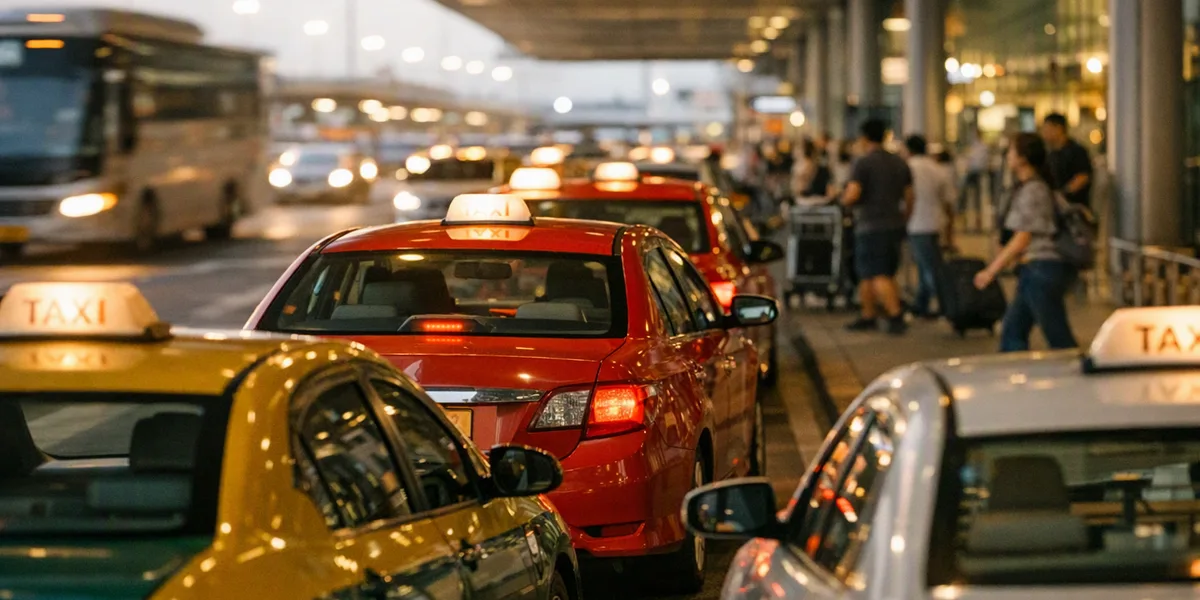
Airport taxi scams cost tourists millions of dollars every year across Asia. The tactics range from subtle (refusing to use the meter) to outright criminal (rigged meters, fake companies, kidnapping to commission-paying hotels). This guide covers the most common scams at Asia's major airports and exactly how to protect yourself. The simplest defense? Pre-book your transfer and have a driver waiting at arrivals with your name.
Vietnam's airports are plagued by fake taxi companies with names nearly identical to legitimate brands. "Mai Linh" becomes "Mailinh" or "Mai Lin." "Vinasun" becomes "Vina Sun" or "VinaSun." The fake taxis look almost identical - same color scheme, similar logo - but have tampered meters that charge 5–10 times the real rate. A 100,000 VND ride becomes 500,000–1,000,000 VND. This scam is especially common at Hanoi Noi Bai (HAN) and Ho Chi Minh City Tan Son Nhat (SGN), where dozens of fake companies operate.
One traveler reported a 7 km ride from SGN to District 1 costing 800,000 VND ($32) instead of the normal 120,000 VND ($5). Defense: only use Mai Linh (green cars) or Vinasun (white cars with a red stripe), use Grab, or pre-book your transfer before you fly.
At Bali's Ngurah Rai Airport (DPS) and Phuket's HKT, local taxi cooperatives have a monopoly on airport transport. Independent drivers and Grab cars are physically prevented from entering the airport compound - security guards turn them away at the gate. The cooperative charges fixed prices that are 2–3 times higher than a normal ride, and there is zero negotiation. At DPS, the airport taxi to Ubud costs $25–40, while a Grab from just outside the compound costs $10–16.
At HKT, the coupon counter charges 800–1,000 THB to Patong, while a Grab would be 500–700 THB. On Lombok (LOP), the same cartel system operates. Defense: pre-book a private transfer before you fly - pre-booked drivers are allowed through the airport gates. Alternatively, walk 5–10 minutes outside the airport perimeter to find a Grab pickup zone, but this is not practical with heavy luggage at night.
This classic Indian scam works like this: you tell the taxi driver your hotel name. The driver makes a phone call, then tells you your hotel is "closed," "burned down," "moved to another location" or "fully booked tonight." He then offers to take you to a "better" hotel - one that pays him a commission of 500–2,000 INR per guest delivered. The commission hotel is always overpriced and underwhelming.
This scam is rampant at Delhi DEL, especially between 10 PM and 6 AM when tired travelers are most vulnerable. Some drivers work with a network of hotels near Paharganj and Karol Bagh, calling ahead to prepare a room at inflated prices. It also occurs at Kolkata CCU and Mumbai BOM. Defense: never believe a taxi driver who says your hotel is closed. Call your hotel directly to confirm.
Better yet, use the prepaid taxi counter where you specify the destination address in advance, or pre-book your transfer so the driver already knows exactly where to go.
Some drivers at Bangkok's airports refuse to use the meter and instead quote a flat fare - always 2–3 times the metered rate. At Suvarnabhumi BKK, the real metered fare to central Sukhumvit is typically 250–400 THB including tolls and the 50 THB surcharge. But an unofficial driver will quote 800–1,200 THB for the same trip. At Don Mueang DMK, the same trick is common but the unofficial drivers are more aggressive because the taxi queue is less organized.
At Jakarta CGK, some drivers claim the meter is "broken" or "not working tonight" and demand a cash price. This also happens at Manila MNL, especially at Terminal 1 where the taxi queue is less controlled. Defense: insist on the meter. If the driver refuses, exit immediately and take the next taxi. At BKK, always use the official taxi queue on Level 1 - all taxis in this queue are required to use meters.
The driver takes a deliberately long route to inflate the metered fare. This is harder to detect if you don't know the city, but a 30-minute ride that takes 90 minutes (without traffic) is a red flag. Defense: show the driver Google Maps with your route, or use Grab which shows the route in the app. A pre-booked transfer with a fixed price eliminates this risk entirely.
At virtually every Asian airport, people will approach you inside the arrivals hall offering "taxi" or "transport." These are unlicensed operators who charge premium rates, often 3–5x the normal fare. They are most aggressive at Delhi, Manila, Bali, Bangkok Don Mueang and Hanoi. Defense: never follow anyone who approaches you. Walk past them to the official taxi queue, use the prepaid counter, or pre-book a legitimate transfer.
The five golden rules: (1) Never follow anyone who approaches you inside the terminal. (2) Only use official taxi queues or prepaid counters. (3) Always insist on the meter. If refused, take the next taxi. (4) Have your hotel address written in the local language. (5) Pre-book your transfer. A driver with your name on a sign, a fixed price and GPS tracking eliminates every scam on this list.
Every issue discussed in this guide - overcharging, scams, language barriers, unreliable apps, long queues - has one simple solution: pre-book your airport transfer before you fly. A pre-booked transfer gives you a fixed price confirmed in advance, a named driver tracking your flight and waiting at arrivals, and zero negotiation. Most vehicle classes can be cancelled free of charge up to 5 hours before pickup, so booking early costs you nothing.
Start by checking our airport guides below for specific local advice, prices and transport options at your arrival airport.
Read our detailed transfer guides for airports mentioned in this article:
Specific route guides with prices and transport comparisons: