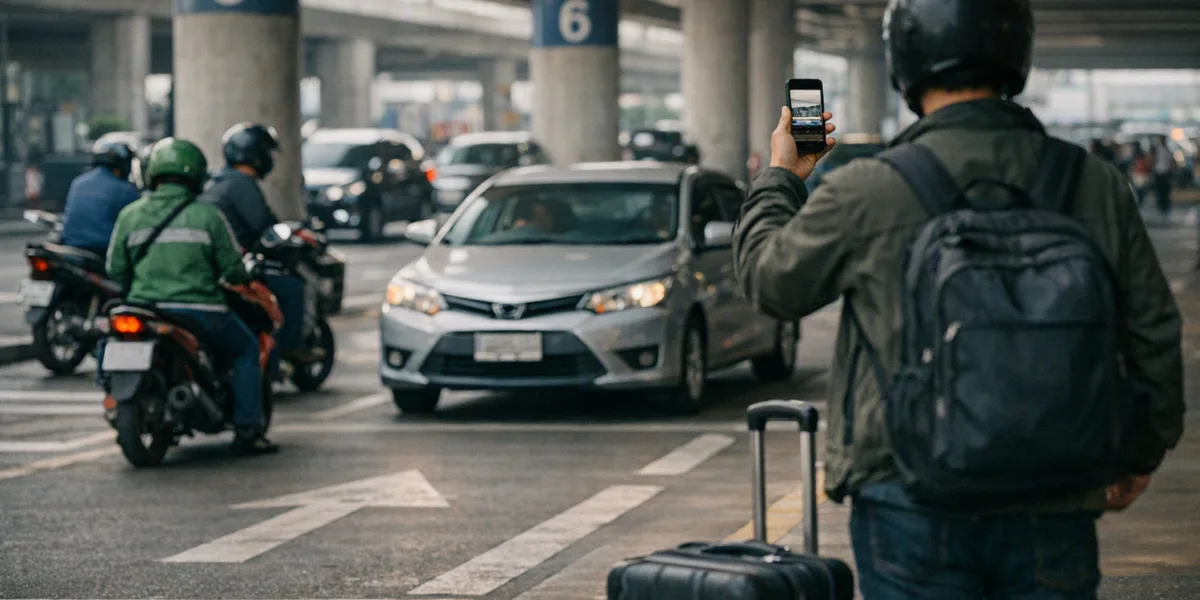
Download the wrong ride app in Asia and you'll stare at a blank map while taxi touts circle. Grab dominates Southeast Asia but won't open in Mumbai. DiDi owns China but disappeared from most other markets. Gojek thrives in Jakarta, barely registers in Bangkok. This guide maps exactly which apps work in which Asian countries in 2026, with real coverage areas, airport pickup rules, and pricing context. Written for travelers who need a ride that actually shows up, not a list of apps that theoretically exist.
Grab operates in eight Southeast Asian countries: Singapore, Malaysia, Thailand, Indonesia, Vietnam, Philippines, Cambodia, and Myanmar. The app launched in Malaysia in 2012 as MyTeksi, rebranded to Grab in 2016, then bought Uber's Southeast Asian operations in 2018. At Bangkok Suvarnabhumi Airport (BKK), Grab drivers pick up from the dedicated ride-hailing zone on Level 2, Gate 4-look for the green "Taxi Meter & Ride App" signs. Fares from BKK to central Bangkok run ฿350-450 ($10-13 USD) depending on traffic, compared to ฿500-600 for airport taxis with the ฿50 airport surcharge.
Singapore Changi Airport (SIN) restricts Grab to specific pickup points at each terminal-Terminal 1 uses Pickup Point 4, Terminal 2 uses Point 6, Terminal 3 uses Point 7. The Singapore government imposes a S$3-5 airport surcharge on all ride-hail trips. Grab doesn't operate in China, India, Japan, South Korea, or the Middle East-common mistake among first-time Asia travelers who assume one app covers the continent.
DiDi controls 90% of China's ride-hailing market with 550 million users, but the app barely exists outside mainland China in 2026. The company pulled out of international markets including Australia, New Zealand, and most of Latin America between 2022-2024 to focus on domestic operations after regulatory pressure from Beijing. DiDi requires a Chinese phone number for registration, though the 2025 update allows international credit cards-previous versions demanded Alipay or WeChat Pay only.
At Beijing Capital Airport (PEK) and Shanghai Pudong (PVG), DiDi operates from designated zones separate from regular taxis; follow signs for 网约车 (wǎngyuēchē, internet-booked cars). A DiDi ride from PVG to central Shanghai costs ¥120-180 ($17-25 USD) for the 40km trip, versus ¥200+ for airport taxis. The app interface offers English, Japanese, and Korean language options, but driver communication defaults to Mandarin-have your destination written in Chinese characters.
DiDi launched limited service in Tokyo in 2018 but never expanded beyond initial test zones; Japan remains dominated by GO (formerly JapanTaxi) and local operators.
Gojek started as a motorcycle taxi dispatch service in Jakarta in 2010 and now operates across Indonesia, Singapore, Thailand, and Vietnam, though the Indonesia operation dwarfs others. The app handles 2.5 million drivers in Indonesia alone, offering GoRide (motorcycles), GoCar (cars), and GoBluebird (official Bluebird taxi integration). At Jakarta Soekarno-Hatta Airport (CGK), Gojek cars pick up from Terminal 2 and Terminal 3 designated zones, but GoRide motorcycles aren't permitted at the airport-you'll need to walk to the nearby Cengkareng area.
Rides from CGK to central Jakarta cost Rp150,000-250,000 ($10-16 USD) for cars, significantly cheaper than the fixed-price airport taxi rate of Rp350,000. Singapore's version rebranded to Gojek from Go-Jek in 2021 but competes poorly against Grab-most locals still default to Grab or ComfortDelGro taxis. Thailand's Gojek launched in 2018 but remains secondary to Grab and Bolt in Bangkok; the app works but driver availability drops notably outside peak hours.
Vietnam operations remain limited to Hanoi and Ho Chi Minh City with modest market share.
India's ride-hailing market splits between domestic champion Ola (65% market share) and Uber (35%), with both apps operational in 100+ cities. Ola dominates tier-2 and tier-3 cities where Uber never established presence; Uber holds stronger in Delhi, Mumbai, and Bangalore among English-speaking users. At Mumbai Chhatrapati Shivaji Airport (BOM), both apps pick up from the multi-level parking plaza-follow signs to P2 or P3 depending on terminal, then match your car's bay number.
Fares from BOM to South Mumbai run ₹600-900 ($7-11 USD) for Ola/Uber versus ₹1,000-1,200 for prepaid airport taxis. Delhi Indira Gandhi Airport (DEL) forces all ride-hail pickups to the ground transportation center, a 5-minute walk from arrivals-annoying with luggage but necessary due to traffic control. Ola accepts UPI, cards, and cash; Uber India added UPI and cash options after initially insisting on cards only.
Both apps offer auto-rickshaw options (Ola Auto, Uber Auto) in most cities at ₹30-50 for short trips, undercutting traditional auto drivers who often refuse meters.
Uber acquired Careem in 2020 for $3.1 billion but kept the brand operating independently across 13 Middle Eastern countries plus Pakistan. Both apps function in the UAE, Saudi Arabia, Egypt, Jordan, and Pakistan, though Careem offers better coverage in smaller cities and Arabic-language interface. Dubai International Airport (DXB) designates specific zones for Uber and Careem at each terminal-Terminal 3 uses Zone D, Terminal 1 uses Zone C. Rides from DXB to Dubai Marina cost AED 80-110 ($22-30 USD) on either platform, compared to AED 120-150 for Dubai Taxi Corporation airport cabs with the AED 25 airport fee.
Abu Dhabi and Sharjah restrict ride-hail pickups at airports to specific licensed vehicles; not all Careem/Uber drivers hold airport permits. Saudi Arabia's GACA (General Authority of Civil Aviation) requires ride-hail drivers to register for airport access-this caused confusion when regulations changed in 2024, leaving some drivers unable to enter airport zones. Careem offers "Careem Kids" with car seats in UAE and Saudi Arabia, useful feature absent from most Asian ride apps.
Estonian company Bolt (formerly Taxify) operates in 15 Asian countries as of 2026, primarily targeting markets where Uber exited or never dominated. The app works in Thailand, Sri Lanka, Bangladesh, Pakistan, Kenya, Tanzania, Uganda, South Africa, Ghana, and Nigeria, plus limited European presence. Bangkok adopted Bolt enthusiastically after launch in 2022-the app offers 15-20% lower fares than Grab on identical routes, undercutting through lower commission rates to drivers.
A Bolt ride from Bangkok Suvarnabhumi (BKK) to Sukhumvit costs ฿300-380 versus Grab's ฿350-450, though driver availability drops late night when Grab's larger fleet dominates. Colombo, Sri Lanka sees active Bolt usage at Bandaranaike International Airport (CMB) with rides to central Colombo running LKR 3,500-4,500 ($12-15 USD). Dhaka, Bangladesh has Bolt competing against local player Pathao and Uber, with Bolt gaining ground through aggressive driver incentives.
Tokyo, Seoul, and mainland China remain untouched by Bolt-company focuses on emerging markets rather than competing in expensive, saturated cities.
inDriver operates in 47 countries with unique twist: passengers name their price, drivers accept or counter-offer. The app works across Central Asia (Kazakhstan, Kyrgyzstan, Uzbekistan), parts of Southeast Asia, India, and Pakistan. Almaty, Kazakhstan sees heavy inDriver usage where passengers typically offer 20-30% below suggested fare, drivers accept 60% of the time. At Nursultan Nazarbayev Airport (NQZ), inDriver rides to central Almaty run ₸3,000-4,000 ($7-9 USD) after negotiation, versus fixed ₸5,000 for airport taxis.
Delhi and Mumbai have growing inDriver adoption among price-sensitive riders-offer ₹400 for a route where Ola quotes ₹550, often a driver accepts within 2 minutes. The negotiation model works poorly at airports during peak hours when driver demand exceeds supply; you'll negotiate against other passengers rather than drivers competing for your fare. Tashkent, Uzbekistan relies heavily on inDriver since Uber and Yandex both exited the market; the app effectively functions as the city's primary ride platform.
Pakistan's major cities (Karachi, Lahore, Islamabad) show strong inDriver growth, appealing to riders frustrated by Careem and Uber's dynamic pricing during rush hours.
Japan operates separately from broader Asian ride-hailing patterns-GO (created from 2020 merger of JapanTaxi and MOV) controls 70% of the taxi-hailing market. The app doesn't offer private drivers like Uber; instead it dispatches licensed taxi companies. At Tokyo Narita Airport (NRT), GO cars pick up from the official taxi queue like any cab-no special zone required. Fixed-price rides from NRT to central Tokyo cost ¥22,000-26,000 ($150-180 USD) depending on destination, identical whether booked via GO or hailed at the stand.
Uber operates in Tokyo, Osaka, Kyoto, and Nagoya but only dispatches licensed taxis, not independent drivers-Japan's strict vehicle-for-hire laws prevent the standard Uber model. DiDi's Tokyo operation remains limited to specific wards with minimal market penetration. S.RIDE and Fulcul offer similar licensed-taxi dispatch in major cities with English interfaces. The practical reality: GO provides widest coverage and English support, but calling a regular taxi often proves faster than app-booking during peak hours.
Osaka Kansai Airport (KIX) charges a ¥1,000-2,000 expressway toll on top of metered fares to central Osaka, regardless of booking method.
Regional apps fill niches across Southeast Asia despite Grab's dominance. InDrive operates in Thailand, Vietnam, Philippines, and Indonesia with growing market share-Bangkok riders use it to undercut Grab's surge pricing during rush hour. TADA launched in Singapore in 2019 offering lower commissions to drivers, briefly gained 15% market share, then struggled to compete long-term against Grab's network effects. MuvMi serves Thailand's Eastern Economic Corridor (Rayong, Chonburi) where Grab coverage thins outside tourist areas.
Vietnam's Be (formerly Be Group) competes aggressively against Grab in Hanoi and Ho Chi Minh City, offering BeRide cars and BeBike motorcycles at 10-20% lower fares. At Tan Son Nhat Airport (SGN) in Ho Chi Minh City, Be drivers pick up from the same zone as Grab with rides to District 1 costing ₫120,000-150,000 ($5-6 USD). Philippines' Angkas specializes in motorcycle taxis across Metro Manila, legal since 2023 regulations finally permitted commercial motorcycle ride-hailing.
MaximTaxi operates in Cambodia, Myanmar, and Laos where Grab's presence remains light-Phnom Penh and Yangon riders often find better Maxim availability in outer neighborhoods.
Airport ride-hailing succeeds when you match app to location and understand local pickup rules. Singapore Changi enforces strict zones but all major apps (Grab, Gojek, TADA) function smoothly-just follow terminal-specific signage to designated points. Bangkok Suvarnabhumi allows Grab, Bolt, and inDriver at Level 2 Gate 4, though some drivers still call asking you to walk to departures level despite official pickup zone. Mumbai and Delhi airports require 5-10 minute walks to designated ride-hail areas, often poorly signed-download offline airport maps before landing.
Dubai's DXB clearly marks Uber/Careem zones with digital boards showing wait times, one of Asia's best-organized systems. Tokyo Narita works easiest-just queue for regular taxis since GO/Uber dispatch the same licensed cabs. Jakarta CGK suffers from confusion between Terminal 2 and Terminal 3 pickup points; verify terminal with driver via app chat before walking. The universal rule: have the app downloaded, account verified, and payment method added before you land.
Airport WiFi often blocks app downloads, local SIM cards take time to activate, and standing in arrivals hall troubleshooting while drivers cancel won't start your trip well.
Every issue discussed in this guide - overcharging, scams, language barriers, unreliable apps, long queues - has one simple solution: pre-book your airport transfer before you fly. A pre-booked transfer gives you a fixed price confirmed in advance, a named driver tracking your flight and waiting at arrivals, and zero negotiation. Most vehicle classes can be cancelled free of charge up to 5 hours before pickup, so booking early costs you nothing.
Start by checking our airport guides below for specific local advice, prices and transport options at your arrival airport.
Read our detailed transfer guides for airports mentioned in this article:
Specific route guides with prices and transport comparisons: