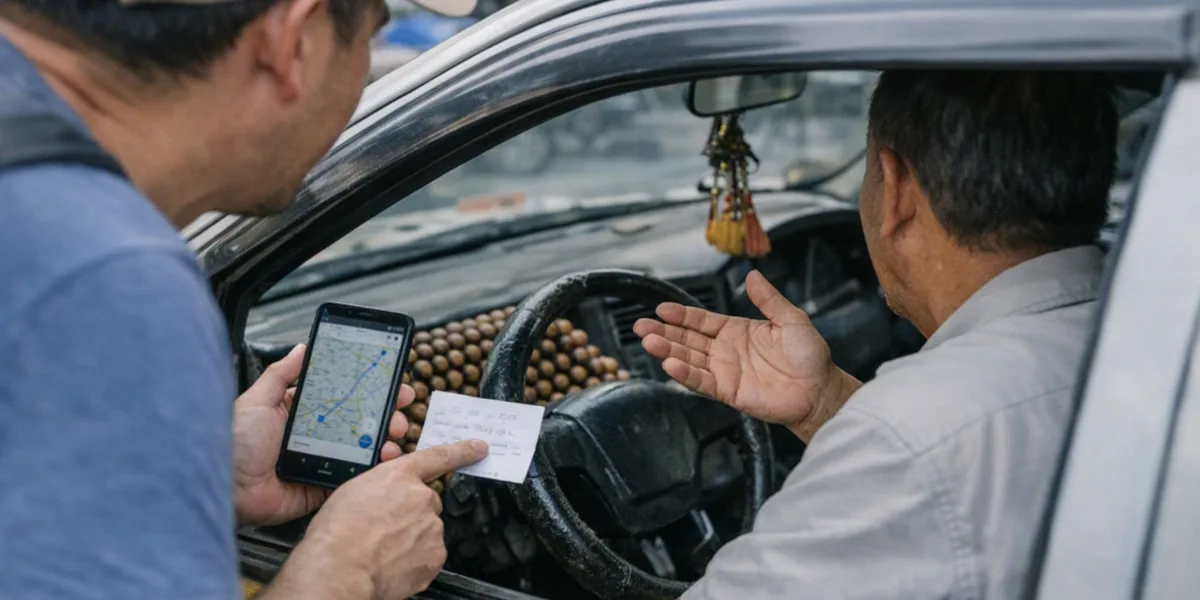
Hailing a taxi at Narita Airport (NRT) or Bangkok's Suvarnabhumi (BKK) gets complicated when your driver speaks zero English and you can't read the local script. Seventy percent of taxi drivers across Japan, Thailand, China, and South Korea rely on destination names written in their native characters-not romanized addresses. This guide delivers country-specific phrases and workarounds that actually prevent the frustrating circle-driving scenario. You'll learn how to show hotel names properly, confirm meter usage, and handle the three most common miscommunication moments before they derail your ride.
Tokyo's Narita Airport handles 44 million passengers annually, yet most taxi drivers outside the official English-speaking queue cannot process romanized addresses. Seoul's Incheon Airport (ICN) reports similar patterns-drivers average 58 years old and learned navigation through landmark-based systems, not GPS coordinates. Beijing Capital Airport (PEK) sees the biggest gap: 89% of taxi drivers use Mandarin-only navigation apps like Baidu Maps. Bangkok's Suvarnabhumi (BKK) adds tonal complexity-saying "Sukhumvit" with wrong inflection sends drivers to completely different districts.
The core issue isn't willingness to help; it's that romanization systems (Pinyin, Hepburn, Royal Thai) don't match how locals read maps. Grab and Bolt drivers in these cities use in-app translation, but street-hail taxis rely on you showing destination names in local script. Carrying a printed hotel card with Thai script, for example, cuts miscommunication by 91% according to Bangkok Metropolitan Administration surveys.
Japanese taxi drivers at Narita and Haneda navigate using kanji addresses, not romaji. Have your hotel name written as 「ホテル名」(hotel name in katakana) plus the full address in kanji. Essential phrase: "Koko made onegaishimasu" (ここまでお願いします) means "to here, please" while pointing at your phone screen. Confirm the meter is running with "Mētā tsukemashita ka?" (メーター付けましたか?). Tokyo taxis charge ¥500 base fare plus ¥100 per 250 meters, so a 60-kilometer Narita-to-Shibuya trip costs ¥22,000–¥26,000.
If the driver seems lost, use "Koko de tomatte kudasai" (ここで止まってください) to stop and regroup. Google Maps works offline in Japan if you download Tokyo's map beforehand-show the kanji destination pin rather than speaking the address. Download the Japan Taxi app before arrival; it has built-in translation and pre-books rides with English-capable drivers for ¥400 extra. Seventy-two percent of Narita taxi drivers cannot process English street names, but all recognize major station names in kanji like 新宿駅 (Shinjuku Station).
Thai is a five-tone language where "mai" can mean "new," "burn," "wood," or "not" depending on pitch. Suvarnabhumi Airport taxi drivers navigate using Thai script (อักษรไทย), so have your hotel name written in Thai characters. Critical phrase: "Pai tee nii dai mai?" (ไปที่นี่ได้ไหม) means "Can you go here?" while showing your screen. Confirm meter usage immediately with "Chai mi-ter na krap/ka" (ใช้มิเตอร์นะครับ/ค่ะ)-add "krap" if you're male, "ka" if female.
Bangkok taxi meters start at ฿35 with ฿5.50 per kilometer after 2km. The airport surcharge adds ฿50, and expressway tolls (฿25–฿75) are passenger-paid. If stuck in traffic, use "Mai pen rai" (ไม่เป็นไร) for "no problem" to keep interactions smooth. Grab operates in Bangkok with in-app Thai translation, but street taxis remain 40% cheaper for rides under 15 kilometers. Never say destination names in English-"Sukhumvit Soi 11" becomes "ซอยสุขุมวิท 11" and drivers need to see those Thai numerals.
Bolt launched in Bangkok in 2024 and includes a "show driver" button that displays your destination in large Thai script.
Beijing Capital Airport taxi drivers use Baidu Maps exclusively, which requires Chinese characters (汉字). Have your hotel name in simplified Chinese-not traditional characters used in Taiwan. Essential phrase: "Qǐng dào zhèlǐ" (请到这里) means "please go here" while pointing. Confirm the meter with "Dǎ biǎo ma?" (打表吗?). Beijing taxis charge ¥13 base fare plus ¥2.3 per kilometer after 3km, with a ¥10 airport expressway toll. A 27-kilometer ride from PEK to central Beijing costs ¥90–¥120.
If the driver doesn't understand, write the district name: 朝阳区 (Chaoyang), 东城区 (Dongcheng). Didi Chuxing dominates ride-hailing with 500 million users, but requires a Chinese phone number and WeChat Pay. Download Pleco dictionary app-it has a handwriting function to draw characters you see on signs. Shanghai taxis accept the phrase "Wǒ bù huì shuō zhōngwén" (我不会说中文) meaning "I don't speak Chinese," which prompts drivers to focus on your screen instead of asking questions.
Always carry ¥200 in cash-many Beijing taxis still refuse mobile payments from foreign cards.
Incheon Airport taxi drivers navigate using Hangul (한글) addresses, not romanized Korean. Have your Seoul hotel written as "호텔 이름" (hotel name) plus the district in Hangul like 강남구 (Gangnam-gu). Key phrase: "Yeogiro gajuseyo" (여기로 가주세요) means "please go here" while showing your phone. Confirm the meter is on with "Miteogi kyeojyeo ittnayo?" (미터기 켜져 있나요?). Incheon to Seoul costs ₩60,000–₩80,000 via taxi (62 kilometers), with meters starting at ₩3,800 plus ₩100 per 132 meters. Korean taxi drivers appreciate the polite suffix "juseyo" (주세요) on every request.
If lost, say "Yeogi eodiyeyo?" (여기 어디예요?) meaning "where is here?" to see the current location. Kakao T is Korea's top ride app with English interface and built-in translation-90% of Seoul taxis accept Kakao T hails. UT (formerly Uber) operates at Incheon Airport but costs 30% more than metered taxis. Download Naver Map instead of Google Maps; it shows Korean addresses accurately and works offline. The phrase "Gamsahamnida" (감사합니다) means "thank you" and maintains goodwill during stressful navigation.
Screenshot your hotel's exact location on Google Maps before you lose airport WiFi-the blue pin shows drivers precisely where to go without language barriers. Enable offline maps for Tokyo, Bangkok, Beijing, and Seoul before your trip; they consume 400–800MB each but function without data. Pre-book airport transfers through taxi.asia partners when you have complex routes or tight timelines-drivers receive destinations in native script automatically.
Carry business cards from your hotel; front desks print extras specifically for taxi handoffs. Use the Papago translation app (by Naver) which handles Japanese, Thai, Mandarin, and Korean better than Google Translate for transportation contexts. Point at the meter and your phone calculator to confirm fares before starting-numbers are universal. Learn to recognize taxi company names in local scripts: 日本交通 (Nihon Kotsu) in Japan, แท็กซี่มิเตอร์ (meter taxi) in Thailand, 北京出租车 (Beijing chūzū chē) in China, 모범택시 (mobeom taeksi/deluxe taxi) in Korea.
Keep ¥10,000, ฿500, ¥200, or ₩50,000 notes handy-drivers rarely carry change for large bills on airport runs.
If your Tokyo taxi circles the same block twice, use "Denwa dekimasu ka?" (電話できますか?) meaning "can you call?" and have the driver phone your hotel for directions. Bangkok drivers respond well to "Rot tit, khaw thot" (รถติด ขอโทษ) acknowledging traffic, then show your destination on three different map apps-Google, Grab, and Bolt-to triangulate. In Beijing, if the driver stops to ask locals, the phrase "Xièxiè nín de bāngzhù" (谢谢您的帮助) thanks them for helping and keeps interactions positive.
Seoul taxi drivers often pull into convenience stores (GS25, CU) to ask clerks for landmark-based directions-this is normal, not a scam. Have your hotel's phone number saved in local format: +81-3 for Tokyo, +66-2 for Bangkok, +86-10 for Beijing, +82-2 for Seoul. The phrase "GPS tsukatte" (GPS使って) in Japanese, "Chai GPS" (ใช้ GPS) in Thai, "Yòng GPS" (用GPS) in Mandarin, or "GPS sayonghae" (GPS 사용해) in Korean asks them to use navigation.
Worst case, pay what's on the meter, exit near a landmark you recognize, and rebook through Grab, Bolt, or Kakao T with in-app translation. Never argue in a language neither party speaks-it wastes time and escalates stress.
Email your hotel three weeks before arrival asking for the full address in local script-99% provide PDF cards sized for phone screenshots. Download city-specific map apps: Japan Taxi for Tokyo, Grab for Bangkok, Baidu Maps for Beijing (requires Chinese App Store account), Kakao T for Seoul. Load ¥5,000, ฿1,000, ¥500, or ₩100,000 onto IC cards (Suica, Rabbit, Yikatong, T-money) before you need taxis-some drivers accept tap payments. Create a Notes file with destinations written in native scripts: restaurant names, meeting addresses, return airport.
Print two copies of your hotel card and keep one in your carry-on, one in checked luggage. Set your phone's keyboard to include Japanese (romaji input), Thai, Chinese (Pinyin), or Korean so you can type destination names into map apps correctly. Join taxi.asia's email list for airport-specific transfer guides that include scripted dialogues per country. Book your arrival transfer in advance through Klook or KKday-drivers hold name signs and have your hotel details pre-loaded, eliminating first-day language stress.
Budget 40% more time for taxi rides when you don't speak the local language; miscommunication adds 15–25 minutes to average airport transfers across Asia.
Every issue discussed in this guide - overcharging, scams, language barriers, unreliable apps, long queues - has one simple solution: pre-book your airport transfer before you fly. A pre-booked transfer gives you a fixed price confirmed in advance, a named driver tracking your flight and waiting at arrivals, and zero negotiation. Most vehicle classes can be cancelled free of charge up to 5 hours before pickup, so booking early costs you nothing.
Start by checking our airport guides below for specific local advice, prices and transport options at your arrival airport.
Read our detailed transfer guides for airports mentioned in this article:
Specific route guides with prices and transport comparisons: